
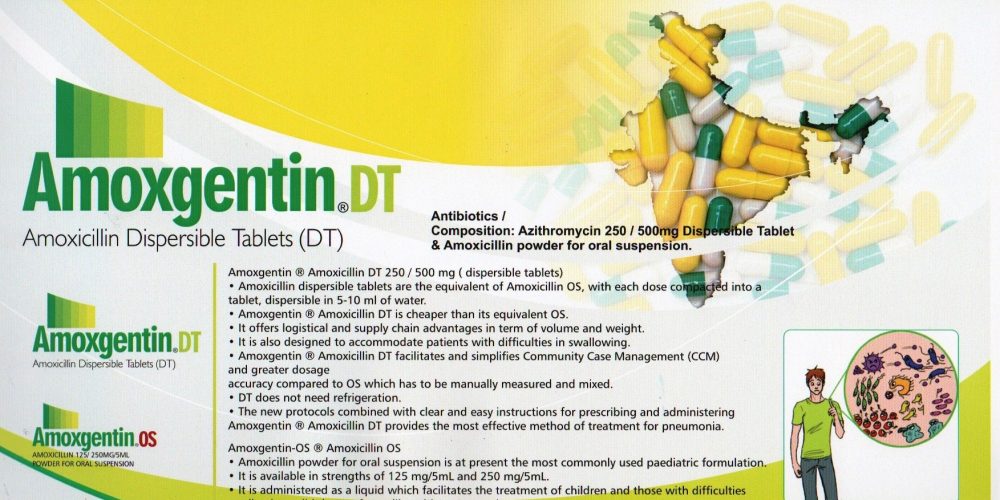
AMOXGENTIN® DT (AMOXICILLIN 250mg 500mg Capsules) BP
Read all of this leaflet carefully before you start taking this medicine because it contains important information for you
• Keep this leaflet. You may need to read it again.
• If you have any further questions, ask your doctor or pharmacist.
• This medicine has been prescribed for you only. Do not pass it on to others. It may harm them, even if their signs of illness are the same as yours.
• If you get any side effects, talk to your doctor or pharmacist. This includes any possible side effects not listed in this leaflet.
IN THIS LEAFLET
1. What your medicine is and what it is used
for
2. Before you take your medicine
3. How to take your medicine
4. Possible side effects
5. How to store your medicine
6. Further information
1. WHAT YOUR MEDICINE IS AND WHAT IT IS USED FOR
AMOXGENTIN® DT contains Amoxicillin as an active ingredient. Amoxicillin is one of a group of antibiotic medicines called penicillins.
AMOXGENTIN® DT works by interfering with the bacteria that cause the infection.
AMOXGENTIN® DT can treat a wide range of infections including those of the following:
Chest (bronchitis or pneumonia) skin
Tonsils (tonsillitis) bone
Ears (otitis media) teeth
Sinuses (sinusitis) heart (endocarditis)
Kidneys gums (abscesses)
Blood (septicaemia)
Abdomen (intra-abdominal sepsis and peritonitis)
The bladder or the urethra (the tube which carries urine from the bladder)
The female reproductive system including infections caused by difficulties during childbirth (puerperal sepsis and septic abortion)
AMOXGENTIN® DT can also be used to treat: gonorrhoea (a sexually transmitted infection) infections associated with pregnancy typhoid and paratyphoid (fevers caused by a group of bacteria called Salmonella)
AMOXGENTIN® DT may also be used in combination with other medicines to treat stomach ulcers.
2. BEFORE YOU TAKE YOUR MEDICINE
Do not take this medicine and consult your doctor if the answer to any of the following is yes:
You have ever had a bad reaction or allergy to any penicillin-type antibiotic
You have ever had a skin rash or swelling of the face or neck or shortness of breath when taking any antibiotic
You are allergic to any of the ingredients contained in this medicine Check with your doctor or pharmacist before taking this medicine if:
You suffer from kidney disease or kidney problems, as you may require a lower dose than normal
You have glandular fever Taking other medicines: Check with your doctor or pharmacist if you are taking, or have recently taken any other medicines even those not prescribed by a doctor. In particular tell your doctor if you are taking any of the following:
The contraceptive pill (in which case you will have to take extra contraceptive measures such as using a condom)
Anticoagulants e.g. warfarin, phenindione Chemotherapy drugs e.g. methotrexate
Drugs used to treat gout (which can be caused by the build up of uric acid) e.g.
probenecid, allopurinol, sulfinpyrazone
Some other antibiotics (e.g. neomycin and tetracyclines can reduce the effect of
AMOXGENTIN® DT)
Oral typhoid vaccine (may not work if taken with AMOXGENTIN® DT) Some penicillins may increase the effects of muscle-relaxing drugs given as part of an anaesthetic for surgery. Tell the doctor you are taking
AMOXGENTIN® DT if you need to have an anaesthetic. Having urine or blood tests
If you are having urine tests for diabetes (sugar in the urine) or blood tests for liver function let the doctor know. AMOXGENTIN® DT can affect the results of these tests. Pregnancy and breast-feeding Check with your doctor before you take this medicine if you are pregnant or breastfeeding.
3. HOW TO TAKE YOUR MEDICINE
Follow all directions given to you by your doctor or pharmacist. Their directions may differ from the information contained in this leaflet. Your doctor may advise you to take your medicine in a different way, so you should always follow your doctor’s advice about when and how to take your medicine and always read the label. Your pharmacist may be able to help if you are not sure.
The maximum daily dose is 6g given in divided doses.
Adults including the elderly:
The usual dose of AMOXGENTIN® DT Capsules is 250mg three times a day
For more severe infections this may be doubled to 500mg three times a day
High doses may be used in the following conditions:
– For severe or recurrent chest infections a dose of 3g twice daily given orally is usually recommended
– For simple urinary tract infections an adult dose of two 3g doses given orally with 10 to 12 hours between doses (short course)
– For the treatment of dental abscesses two 3g doses given orally with 8 hours between doses is recommended
– For gonorrhoea a single 3g dose given orally is recommended
– For stomach ulcers, the following may be prescribed with other antibiotics: 1 x 750mg or 1 x 1g twice a day for 7 days.
The following are the usual adult dosages for preventing infection during dental
procedures and other surgery:
If a general anaesthetic is not used, 3g given orally one hour before surgery and another dose six hours later if necessary
If a general anaesthetic is used, 3g given orally four hours before anaesthesia and 3g six hours after the initial dose Children
It is recommended that children be given AMOXGENTIN® DT as a suspension instead of as capsules.
Children weighing more than 40kg should be given the usual adult dosage.
Children weighing less than 40kg who are able to swallow capsules: All doses are
worked out depending on the child’s body weight in kilograms. Your doctor will advise you how much medicine you should give to your baby or child.
The usual dose is 40mg to 90mg for each kilogram of body weight a day, given in two or three divided doses.
Patients with kidney problems If you have kidney problems, the dose prescribed by your doctor may be lower than the usual dose.
When to take your medicine Try to give/take this medicine as part of the
daily routine, for example at mealtimes. You may give/take AMOXGENTIN® DT before, with or after food, unless the label advises a specific time. It is not normally necessary to arrange to have a dose in the middle of the night, unless your doctor has told you to do so. But remember, space the doses as evenly
as possible throughout the day.
Do not give/take more than one dose every four hours.
If you forget to take your medicine If you forget to take a dose, take it as soon as
you remember, unless it is within an hour of your next dose, then carry on as before. Do not take a double dose to make up for the dose you have missed.
If you take more of your medicine than you should If you take more capsules than you should, tell your doctor immediately or go to the nearest hospital. You should take this leaflet and any capsules you still have to show the doctor. Severe cases of nausea, vomiting and diarrhoea can be treated with rehydration therapy, by drinking fluids containing sodium, water and sugar to prevent dehydration.
REMEMBER:
Keep taking this medicine until it is finished oryour doctor tells you to stop. Do not stop taking it just because you feel better. If you stop taking the medicine, some bacteria may survive and cause the infection to come back, or your condition may re-occur or get worse. You should make sure you have several more
drinks of water each day unless told otherwise by your doctor. If you are still unwell after taking all the medicine, go and see your doctor. Never give/take more than the recommended dose each day.
4. POSSIBLE SIDE EFFECTS
As with all medicines, some people may experience side effects with AMOXGENTIN® DT. If you experience any of the following events STOP taking your medicine and tell your doctor or go to your nearest hospital immediately:
Hypersensitivity or severe allergic reaction including swollen face or breathing problems. If these symptoms occur, STOP taking AMOXGENTIN® DT right away and tell your doctor.
Severe diarrhoea with bleeding
Allergic skin reactions with itching e.g. hives, nettle rash, blistering or peeling of the skin. If you start to itch or get a rash, STOP taking AMOXGENTIN® DT and tell your doctor immediately.
Convulsions may occur in patients on high doses or with kidney problems
Notice your urine becoming darker or your faeces becoming paler
Notice your skin or the white of your eyes turning yellow (jaundice)
Difficulty or discomfort in passing urine or having cloudy urine
The following symptoms are less serious but you may wish to discuss them with your doctor if they become troublesome or last a long time.
Common side effects of AMOXGENTIN® DT (i.e. have been reported in more than 1 in 100 people taking it) include:
Nausea (feeling sick) or diarrhoea Uncommon side effects (i.e. have been reported in between 1 in 100 and 1 in 1,000 people taking AMOXGENTIN® DT) include:
Vomiting Very rare side effects (i.e. reported in less than 1 in 10,000 people) include:
Thrush (a yeast infection of the vagina, mouth or skin folds). You can get treatment for thrush from your doctor or pharmacist.
Tooth discolouration.
The colour usually returns to normal with brushing.
Blackening of the tongue Inflammation of the kidney
Excessive body movements (hyperkinesia) or dizziness Reduction (reversible) in blood cell counts including anaemia (a reduction in the body’s red blood cells or haemoglobin which may be characterised by feeling weak or light-headed) or a longer time taken for blood to clot. Tell your doctor that you are taking AMOXGENTIN® DT if you are having blood tests.
Crystalluria, forming of crystals in the urine If you notice any side effects not mentioned in this leaflet, please inform your doctor or
pharmacist.
5. HOW TO STORE YOUR MEDICINE
Do not use your medicine after the expiry date shown on the label.
Store your medicine below 25°C and protect it from light and moisture.
Keep all medicines out of the reach and sight of children.
If your doctor tells you to stop your treatment, return any left over to the pharmacist. Only keep it if your doctor tells you to. Medicines should not be disposed of via wastewater or household waste. Ask your pharmacist how to dispose of medicines no longer required. These measures will help protect the environment.
6. FURTHER INFORMATION
The name of your medicine is AMOXGENTIN® DT . AMOXGENTIN® DT Capsules are available only on prescription from your doctor. What
AMOXGENTIN® DT capsules contain Each capsule contains either 250 mg or 500 mg of Amoxicillin as Amoxicillin trihydrate. The capsules also contain the following inactive ingredients: magnesium stearate, maize starch, gelatin, erythrosin (E127), quinoline yellow (E104), titanium dioxide
(E171), red iron oxide (E172). What AMOXGENTIN® DT capsules look like
and contents of the pack AMOXGENTIN® DT Capsules are scarlet and ivory opaque hard gelatin capsules.
Securitainers are available in pack sizes of 15,
18, 20, 21, 28, 30, 50, 100, 500 & 1000 capsules, the pack size of 1000 is available for the 250mg strength only.
Blister packs are available in pack sizes of 15, 16, 18, 20, 21, 28, 30, 50, 100, 500 & 1000 capsules, the pack size of 1000 is available for the 250mg strength only and the pack size of 16 is available for the 500mg strength only.
Not all pack sizes may be marketed
Children weighing less than 40kg who are able to swallow capsules: All doses are worked out depending on the child’s body weight in kilograms. Your doctor will advise you how much medicine you should give to your baby or child. The usual dose is 40mg to 90mg for each kilogram of body weight a day, given in two or three divided doses.
Manufactured By:
TAJ PHARMACEUTICALS Ltd.
Mumbai, INDIA