
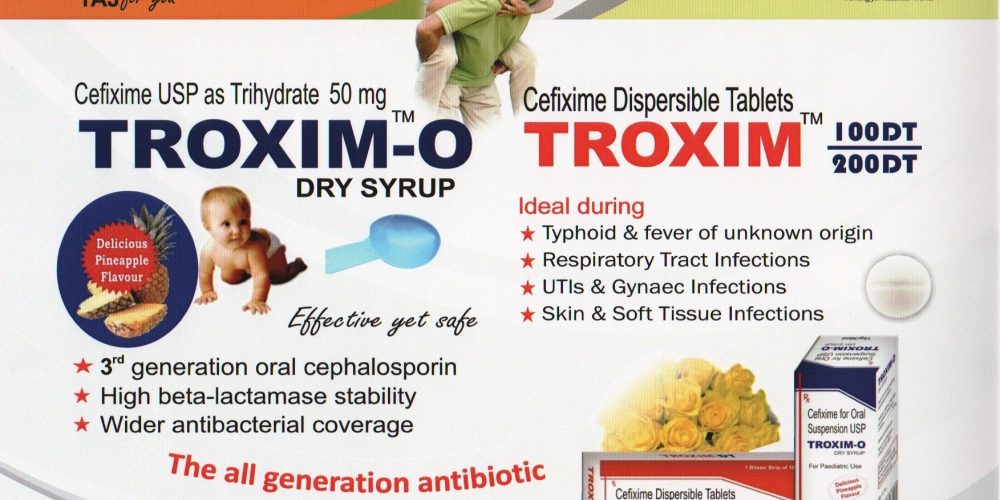
Each 5ml of reconstituted suspension contains
Composition
Cefixime USP as Trihydrate equivalent to
Anhydrous Cefixime………………………………………….50 mg
Indications
Troxim-O is a semi-synthetic third generation oral cephalosporin with a broad spectrum of antibacterial activity against many Gram positive and Gram negative bacteria.
Description
Cefixime binds to specific penicillin-binding proteins (PBPs) located inside the bacterial cell wall, causing the inhibition of the third and last stage of bacterial cell wall synthesis. Cell lysis is then mediated by bacterial cell wall autolytic enzymes such as autolysins; it is possible that cefixime interferes with an autolysin inhibitor.
Contraindications
Cefixime is contraindicated in patients with known allergy to the cephalosporin group of antibiotics
Dosage
Disperse one tablet in 5ml (one teaspoonful) of boiled and cooled water immediately before use
Presentations
60 ml Dry Syrup
Each uncoated dispersible 100 mg tablet contains
Composition
Cefixime USP as trihydrate equivalent to
Anhydrous Cefixime………………………………………………….100 mg
Each uncoated dispersible 200 mg tablet contains
Composition
Cefixime USP as trihydrate equivalent to
Anhydrous Cefixime………………………………………………….200 mg
Indications
Respiratory tract infections (including ear, nose and throat infections) Caused by group A beta-haemolytic Streptococci. Skin and skin structure infections Caused by Staphylococci (including coagulase-positive, coagulase-negative and penicillinase producing strains) and Streptococcus pneumoniae.
Description
Like all beta-lactam antibiotics, cefixime binds to specific penicillin-binding proteins (PBPs) located inside the bacterial cell wall, causing the inhibition of the third and last stage of bacterial cell wall synthesis. Cell lysis is then mediated by bacterial cell wall autolytic enzymes such as autolysins; it is possible that cefixime interferes with an autolysin inhibitor.
Dosage
Disperse one tablet in 5ml (one teaspoonful) of boiled and cooled water immediately before use
Presentations
100 mg of 10 tablet
200 mg of 10 tablet
Cefixime Tablets IP 400mg (Troxim-DT) Taj Pharma
Overview
INTRODUCTION OF TROXIM-DT TABLET DT
Troxim-DT 100 mg Tablet is an antibiotic belonging to the cephalosporin group, which is used to treat a variety of bacterial infections. It is effective in infections of the respiratory tract (eg. pneumonia), urinary tract, ear, nasal sinus, throat, and some sexually transmitted diseases.
Troxim-DT 100 mg Tablet may be taken on an empty stomach or without food. You should take it regularly at evenly spaced intervals as per the schedule prescribed by your doctor. Taking it at the same time every day will help you to remember to take it. The dose will depend on what you are being treated for, but you should always complete a full course of this antibiotic as prescribed by your doctor. Do not stop taking it until you have finished, even when you feel better. If you stop taking it early, some bacteria may survive and the infection may come back or worsen. It will not work for viral infections such as flu or the common cold. Using any antibiotic when you do not need it can make it less effective for future infections.
The most common side effects of this medicine include vomiting, nausea, stomach pain, indigestion, and diarrhea. These are usually mild but let your doctor know if they bother you or do not go away.
Before taking it, you should let your doctor know if you are allergic to any antibiotics or have any kidney or liver problems. You should also let your healthcare team know all other medicines you are taking as they may affect, or be affected by this medicine. This medicine is generally regarded as safe to use during pregnancy and breastfeeding if prescribed by a doctor.
USES OF TROXIM-DT TABLET DT
- Bacterial infections
TROXIM-DT TABLET DT SIDE EFFECTS
- Vomiting
- Nausea
- Stomach pain
- Indigestion
- Diarrhea
HOW TO USE TROXIM-DT TABLET DT
HOW TROXIM-DT TABLET DT WORKS
TROXIM-DT TABLET DT RELATED WARNINGS
Alcohol
Pregnancy
Lactation
Avoid prolonged use of Troxim-DT 100 mg Tablet, since it may have possible effects such as rash and diarrhea.
Driving
Kidney
Liver
WHAT IF YOU MISS A DOSE OF TROXIM-DT TABLET DT?
Cefixime Tablets IP 400mg (Troxim-DT) Taj Pharma
- NAME OF THE MEDICINAL PRODUCT:
Cefixime Tablets IP 100mg (Troxim-DT) Taj Pharma
Cefixime Tablets IP 200mg (Troxim-DT) Taj Pharma
Cefixime Tablets IP 400mg (Troxim-DT) Taj Pharma
2. QUALITATIVE AND QUANTITATIVE COMPOSITION:
a) Each film-coated tablet contains:
Cefixime IP (as Trihydrate) equivalent to
Cefixime Anhydrous 100mg
Excipients q.s.
Colour: Titanium Dioxide IP
b) Each film-coated tablet contains:
Cefixime IP (as Trihydrate) equivalent to
Cefixime Anhydrous 200mg
Excipients q.s.
Colour: Titanium Dioxide IP
c) Each film-coated tablet contains:
Cefixime IP (as Trihydrate) equivalent to
Cefixime Anhydrous 400mg
Excipients q.s.
Colour: Titanium Dioxide IP
3. PHARMACEUTICAL FORM:
Film-Coated Tablet
Description:
Cefixime, an antibiotic, is a third-generation cephalosporin like ceftriaxone and cefotaxime. Cefixime is highly stable in the presence of beta-lactamase enzymes. As a result, many organisms resistant to penicillins and some cephalosporins due to the presence of beta-lactamases, may be susceptible to cefixime. The antibacterial effect of cefixime results from inhibition of mucopeptide synthesis in the bacterial cell wall.
4. CLINICAL PARTICULARS:
4.1. Therapeutic indications:
For use in the treatment of the following infections when caused by susceptible strains of the designated microorganisms: (1) uncomplicated urinary tract infections caused by Escherichia coli and Proteus mirabilis, (2) otitis media caused by Haemophilus influenzae (beta-lactamase positive and negative strains), Moraxella catarrhalis (most of which are beta-lactamase positive), and S. pyogenes, (3) pharyngitis and tonsillitis caused by S. pyogenes, (4) acute bronchitis and acute exacerbations of chronic bronchitis caused by Streptococcus pneumoniae and Haemophilus influenzae (beta-lactamase positive and negative strains), and (5) uncomplicated gonorrhea (cervical/urethral) caused by Neisseria gonorrhoeae (penicillinase- and non-penicillinase-producing strains).
4.2. Dosage and administration:
Dosing: Adult
Usual dosage range: Oral: 400 mg daily divided every 12 to 24 hours.
Gonococcal infection, uncomplicated infections of the cervix, urethra or rectum (rectum off-label use): Oral: 400 mg as a single dose in combination with oral azithromycin as a single dose
Gonococcal infection, expedited partner therapy (off-label use): Oral: 400 mg as a single dose in combination with oral azithromycin
Rhinosinusitis, acute bacterial (alternative agent for penicillin-allergic patients able to tolerate cephalosporins) (off-label use): Oral: 400 mg once daily for 5 to 7 days; if concern for pneumococcal resistance, add clindamycin. Note: In uncomplicated acute bacterial rhinosinusitis, initial observation and symptom management without antibiotic therapy is appropriate in most patients.
Streptococcal pharyngitis (group A) (alternative agent for mild [non-anaphylactic] penicillin allergy): Oral: 400 mg once daily for 10 days
Manufacturer’s labeling: Dosing in the prescribing information may not reflect current clinical practice: 200 mg twice daily
Typhoid fever (off-label use): Oral: 100 to 200 mg twice daily for 7 to 14 days (WHO 2003)
Urinary tract infection (UTI) (alternative agent): Note: Use with caution and only when recommended agents cannot be used (due to decreased efficacy of oral beta-lactams compared to other agents).
Cystitis, acute uncomplicated: Oral: 400 mg once daily for 7 days
UTI, complicated, including pyelonephritis: Oral: 400 mg once daily for 10 to 14 day; Johnson 2018). Note: Oral therapy should follow appropriate parenteral therapy. For outpatient treatment of mild infection, a single dose of a long-acting parenteral agent is acceptable.
Dosing: Geriatric
Refer to adult dosing.
Dosing: Pediatric
Note: Unless otherwise specified, any dosage form may be used.
General dosing; susceptible infection (mild to moderate): Infants, Children, and Adolescents: Oral: 8 mg/kg/day divided every 12 to 24 hours; maximum daily dose: 400 mg/day
Febrile neutropenia (low-risk): Limited data available: Infants, Children, and Adolescents: Oral: 8 mg/kg/day in divided doses every 12 to 24 hours; in most trials, cefixime therapy was initiated as step-down therapy after 48 to 72 hours of empiric parenteral antibiotic therapy with first cefixime dose administered at the end of the last IV infusion. Note: In clinical trials, doses were repeated if patient vomited within 2 hours.
Gonococcal infection, uncomplicated infections of the cervix, urethra, or rectum: Children ≥45 kg and Adolescents: Oral: 400 mg as a single dose in combination with oral azithromycin as a single dose
Irinotecan-associated diarrhea, prophylaxis: Limited data available: Infants, Children, and Adolescents: Oral: 8 mg/kg once daily; begin 5 days before oral irinotecan therapy and continue throughout course
Otitis media, acute: Oral suspension or chewable tablets: Infants, Children, and Adolescents: Oral: 8 mg/kg/day divided every 12 to 24 hours; maximum daily dose: 400 mg/day
Pharyngitis or tonsillitis; S. pyogenes: Note: Not preferred for treatment in IDSA Guidelines due to unnecessary broad spectrum, and lack of selectivity for antibiotic resistant flora; Infants, Children, and Adolescents: Oral: 8 mg/kg/day in divided doses every 12 to 24 hours for ≥10 days; maximum daily dose: 400 mg/day
Pneumonia, community-acquired (CAP); haemophilus influenza types A-F or nontypeable; mild infection or step-down therapy: Infants ≥3 months, Children, and Adolescents: Oral: 8 mg/kg/day in divided doses every 12 to 24 hours; maximum daily dose: 400 mg/day
Rhinosinusitis, acute bacterial: Infants, Children, and Adolescents: Oral: 4 mg/kg/dose every 12 hours with concomitant clindamycin for 10 to 14 days; maximum daily dose: 400 mg/day. Note: Recommended in patients with non-type I penicillin allergy, after failure of initial therapy or in patients at risk for antibiotic resistance (eg, daycare attendance, age <2 years, recent hospitalization, antibiotic use within the past month).
Typhoid fever (Salmonella typhi): Limited data available; efficacy results variable: Infants, Children and Adolescents: Oral: 7.5 to 10 mg/kg/dose every 12 hours for 7 to 14 days
Urinary tract infection; acute: Oral:
Manufacturer’s labeling: Infants ≥6 months, Children, and Adolescents: 8 mg/kg/day in divided doses every 12 to 24 hours; maximum daily dose: 400 mg/day
Alternate dosing: Infants ≥2 months and Children ≤2 years: Initial: 8 mg/kg/day every 24 hours for 7 to 14 days; in patients <24 months, shorter courses (1 to 3 days) have been shown to be inferior to longer durations of therapy (AAP 2011)
Reconstitution
Powder for suspension: Refer to manufacturer’s product labeling for reconstitution instructions.
Administration
May be administered with or without food. Shake oral suspension well before use. Chewable tablets must be chewed or crushed before swallowing.
Dietary Considerations
Chewable tablets contain phenylalanine; avoid use or use with caution in patients with phenylketonuria (PKU).
4.3. Contraindications:
Hypersensitivity to cefixime, any component of the formulation, or other cephalosporins or penicillins.
4.4. Warnings and Precautions:
Concerns related to adverse effects:
- Dermatologic reactions: Severe cutaneous reactions (eg, toxic epidermal necrolysis, Stevens-Johnson syndrome, drug rash with eosinophilia and systemic symptoms [DRESS]) have been reported. If a reaction occurs, discontinue and institute supportive therapy.
- Hemolytic anemia: Immune-mediated hemolytic anemia (including fatalities) have been reported. Monitor patient (including hematologic parameters and drug-induced antibody testing when clinically appropriate) during and for 2 to 3 weeks after therapy. If hemolytic anemia occurs during therapy, discontinue use.
- Hypersensitivity: Hypersensitivity and anaphylaxis have been reported in patients receiving beta-lactam drugs. Use caution in patients with a history of hypersensitivity to cephalosporins, penicillins, or other beta-lactams. If administered to penicillin-sensitive patients, use with caution and discontinue use if allergic reaction occurs.
- Renal failure: May cause acute renal failure including tubulointerstitial nephritis. If renal failure occurs, discontinue and initiate appropriate supportive therapy.
- Superinfection: Prolonged use may result in fungal or bacterial superinfection, including C. difficile-associated diarrhea (CDAD) and pseudomembranous colitis; CDAD has been observed >2 months postantibiotic treatment.
Disease-related concerns:
- Renal impairment: Use with caution in patients with renal impairment; may increase the risk of seizures if dosage not reduced; modify dosage.
- Gastrointestinal disease: Use with caution in patients with a history of gastrointestinal disease.
- Hemolytic anemia: Should not be administered to patients with a history of cephalosporin-associated hemolytic anemia; recurrence of hemolysis is more severe.
Dosage form specific issues:
- Benzyl alcohol and derivatives: Some dosage forms may contain sodium benzoate/benzoic acid; benzoic acid (benzoate) is a metabolite of benzyl alcohol; large amounts of benzyl alcohol (≥99 mg/kg/day) have been associated with a potentially fatal toxicity (“gasping syndrome”) in neonates; the “gasping syndrome” consists of metabolic acidosis, respiratory distress, gasping respirations, CNS dysfunction (including convulsions, intracranial hemorrhage), hypotension, and cardiovascular collapse; some data suggests that benzoate displaces bilirubin from protein binding sites; avoid or use dosage forms containing benzyl alcohol derivative with caution in neonates. See manufacturer’s labeling.
- Phenylalanine: Chewable tablets contain phenylalanine; avoid use or use with caution in patients with phenylketonuria (PKU).
Monitoring Parameters
Renal function; with prolonged therapy, monitor renal and hepatic function periodically. Observe for signs and symptoms of anaphylaxis during first dose. When used as part of alternative treatment for gonococcal infection, test-of-cure 7 days after dose.
4.5. Drug Interactions:
Aminoglycosides: Cephalosporins (3rd Generation) may enhance the nephrotoxic effect of Aminoglycosides. Monitor therapy
BCG (Intravesical): Antibiotics may diminish the therapeutic effect of BCG (Intravesical). Avoid combination
BCG Vaccine (Immunization): Antibiotics may diminish the therapeutic effect of BCG Vaccine (Immunization). Monitor therapy
Cholera Vaccine: Antibiotics may diminish the therapeutic effect of Cholera Vaccine. Management: Avoid cholera vaccine in patients receiving systemic antibiotics, and within 14 days following the use of oral or parenteral antibiotics. Avoid combination
Lactobacillus and Estriol: Antibiotics may diminish the therapeutic effect of Lactobacillus and Estriol. Monitor therapy
Probenecid: May increase the serum concentration of Cephalosporins. Monitor therapy
Sodium Picosulfate: Antibiotics may diminish the therapeutic effect of Sodium Picosulfate. Management: Consider using an alternative product for bowel cleansing prior to a colonoscopy in patients who have recently used or are concurrently using an antibiotic. Consider therapy modification
Typhoid Vaccine: Antibiotics may diminish the therapeutic effect of Typhoid Vaccine. Only the live attenuated Ty21a strain is affected. Management: Vaccination with live attenuated typhoid vaccine (Ty21a) should be avoided in patients being treated with systemic antibacterial agents. Use of this vaccine should be postponed until at least 3 days after cessation of antibacterial agents. Consider therapy modification
Vitamin K Antagonists (eg, warfarin): Cephalosporins may enhance the anticoagulant effect of Vitamin K Antagonists. Monitor therapy
Test Interactions
Positive direct Coombs’, false-positive urinary glucose test using cupric sulfate (Benedict’s solution, Clinitest®, Fehling’s solution), may cause false-positive serum or urine creatinine with the alkaline picrate-based Jaffé reaction for measuring creatinine; false-positive urine ketones using tests with nitroprusside (but not those using nitroferricyanide).
4.6. Pregnancy:
Cefixime crosses the placenta and can be detected in the amniotic fluid.
An increased risk of major birth defects or other adverse fetal or maternal outcomes has generally not been observed following use of cephalosporin antibiotics.
4.7. Undesirable effects:
>10%: Gastrointestinal: Diarrhea (16%)
2% to 10%: Gastrointestinal: Abdominal pain, nausea, dyspepsia, flatulence, loose stools
<2%: Acute renal failure, anaphylactoid reaction, anaphylaxis, angioedema, candidiasis, dizziness, drug fever, eosinophilia, erythema multiforme, facial edema, fever, headache, hepatitis, hyperbilirubinemia, increased blood urea nitrogen, increased serum creatinine, increased serum transaminases, jaundice, leukopenia, neutropenia, prolonged prothrombin time, pruritus, pseudomembranous colitis, seizure, serum sickness-like reaction, skin rash, Stevens-Johnson syndrome, thrombocytopenia, toxic epidermal necrolysis, urticaria, vaginitis, vomiting
5. PHARMACOLOGICAL PROPERTIES:
5.1. Pharmacodynamic properties:
Cefixime, an antibiotic, is a third-generation cephalosporin like ceftriaxone and cefotaxime. Cefixime is highly stable in the presence of beta-lactamase enzymes. As a result, many organisms resistant to penicillins and some cephalosporins due to the presence of beta-lactamases, may be susceptible to cefixime. The antibacterial effect of cefixime results from inhibition of mucopeptide synthesis in the bacterial cell wall.
5.2. Pharmacokinetic properties:
Mechanism of Action
Like all beta-lactam antibiotics, cefixime binds to specific penicillin-binding proteins (PBPs) located inside the bacterial cell wall, causing the inhibition of the third and last stage of bacterial cell wall synthesis. Cell lysis is then mediated by bacterial cell wall autolytic enzymes such as autolysins; it is possible that cefixime interferes with an autolysin inhibitor.
Absorption
About 40%-50% absorbed orally whether administered with or without food, however, time to maximal absorption is increased approximately 0.8 hours when administered with food.
Distribution
Widely throughout the body and reaches therapeutic concentration in most tissues and body fluids, including synovial, pericardial, pleural, peritoneal; bile, sputum, and urine; bone, myocardium, gallbladder, and skin and soft tissue.
Excretion
Urine (50% of absorbed dose as active drug); feces (10%).
Half-life Elimination
Normal renal function: 3 to 4 hours; Moderate impairment (CrCl 20 to 40 mL/minute): 6.4 hours; Renal failure: Up to 11.5 hours.
- PHARMACEUTICAL PARTICULARS:
6.1. Incomaptibilities:
None stated.
6.2. Shelf life:
3 years
6.3. Storage and handling instructions:
Store at 20°C to 25°C (68°F to 77°F).
6.4. Packaging information:
Available in strips of alu-alu packaging of 10 tablets.
Not all pack sizes may be marketed.
6.5. Special precautions for disposal and other handling:
N/A
7. Manufactured in India By:
TAJ PHARMACEUTICALS LIMITED
At Plot No.: 220, Mahagujarat Industrial Estate,
At & Post: Moraiya, Tal – Sanand, Dist. Ahmedabad, Gujarat, INDIA.